The shortest seat at the table: how to make it last
Updated: Oct 6

4.1 years.
That's the average CMO tenure at S&P 500 companies in 2025. This is the shortest of any C-suite role, and after a brief recovery, it’s falling again.
CEOs average 7.6 years. CFOs average 4.7. Even COOs, long assumed to have the most precarious seat, are closing the gap.
And yet the headline number flatters the reality. In tech, the average CMO tenure runs 3 to 3.5 years. In B2B financial services, 3.5 to 4.0. In B2B specifically, the world most readers of this newsletter inhabit, the data puts it closer to 18 to 24 months.
That's barely enough time to run one planning cycle, let alone prove a strategy.
So, when the office plants start to outlive the CMOs, here's a question worth sitting with:
is short CMO tenure inevitable, or is it something CMOs are partly doing to themselves?
The real reasons CMOs leave
The popular narrative is that CMOs are victims of impatient boards and short-termist CFOs. There's truth in that. But it's an incomplete story, not to mention and an unhelpful one, because it locates the problem entirely outside the CMO's control.
The data tells a more nuanced picture.
31% of S&P 500 companies have eliminated the CMO title entirely. But Forrester finds that 65% of CMO exits are lateral moves or promotions rather than failures. 10% of departing CMOs become CEOs with 37% of Fortune 500 CEOs having a marketing background.
The role isn't dying, it's diverging into CMOs who've built the credibility to advance, and CMOs who haven't built it fast enough.
Three structural causes drive most involuntary exits:
CEO turnover.
New CEOs replace the CMO first, more often than any other direct report. The relationship with the incoming CEO isn't inherited, it has to be rebuilt from zero. CMOs who've invested in relationships across the C-suite survive CEO transitions more often than those who've invested solely upward.
Scope drift.
The CMO role has the least standardised remit of any C-suite position. 81% of CMOs now oversee digital customer experience. 84% manage corporate communications. AI governance, brand safety, data compliance – all of it is landing on the CMO's desk. Companies don't just replace CMOs, they redesign the job, then hire someone who fits the new version. CMOs who didn't negotiate scope at the point of hire are frequently evaluated against expectations that were never made explicit.
The expectations gap.
Only half of CEO-CMO pairs at the same company give the same answer when asked what the primary role of marketing is. Nine in ten CEOs believe marketing's remit is well defined. Their CMOs frequently disagree. That gap, which can be invisible on day one but fatal by month eighteen, is the most common reason good CMOs fail in the wrong organisations.

Sources: Spencer Stuart CMO Tenure Study 2025 · Forrester · McKinsey CEO-CMO Survey · Adweek
What separates the ones who last
This is where it gets interesting, because the data on CMO longevity points to factors that are largely within the CMO's control.


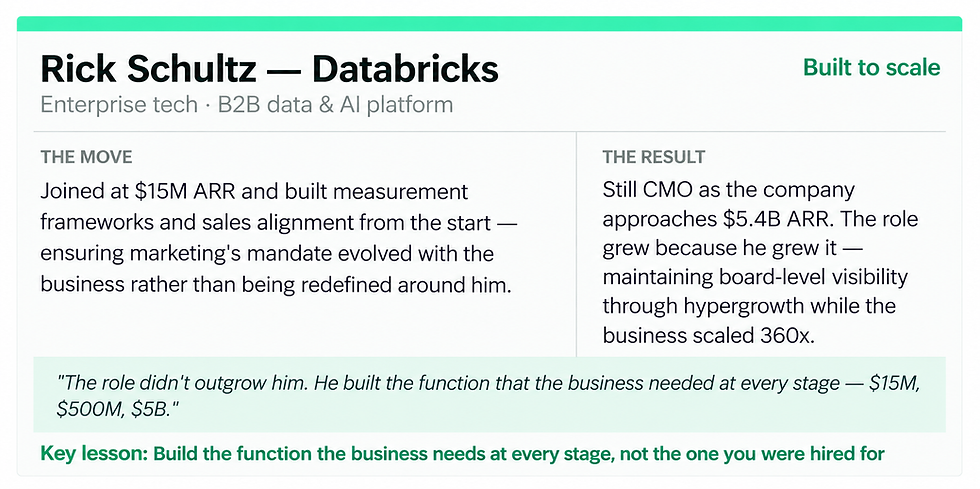
The survival playbook
Most CMO tenure advice focuses on what to do once you're under pressure. That's too late.
Four ways to ensure tenure is built in the first six months:
Before you accept the role: Define the mandateAgree exactly what you own, how success will be measured, and what good looks like after 12 and 24 months.
First 90 days: Deliver an early winSecure one visible result quickly, build a strong relationship with sales, and establish credibility with the board.
Year one: Own the numbersSet the metrics and attribution model early so marketing’s impact on revenue is clear and agreed.
Ongoing: Manage leadership relationshipsInvest in relationships beyond the CEO and reset your approach whenever leadership changes.
The bottom line
The CMOs who last aren't the ones who outlast the scrutiny. They're the ones who never gave it a reason to start. Tenure is built before the pressure arrives - through scope clarity, early wins, financial fluency, and relationships that run deeper than the one directly above you.
The question that predicts everything
Before your next career move, or even before the next board meeting, ask yourself this:
"Does my CEO and I have the same answer to the question: what is marketing's primary role in this business?"
If you're not sure, find out.
Because the CMOs who stay the distance aren't the ones who outlast the scrutiny. They're the ones who never gave it a reason to start.
CMO Insider is written for senior marketing leaders in financial services, technology and telecommunications. If this issue was useful, forward it to a CMO who's asking the right questions.


Comments